
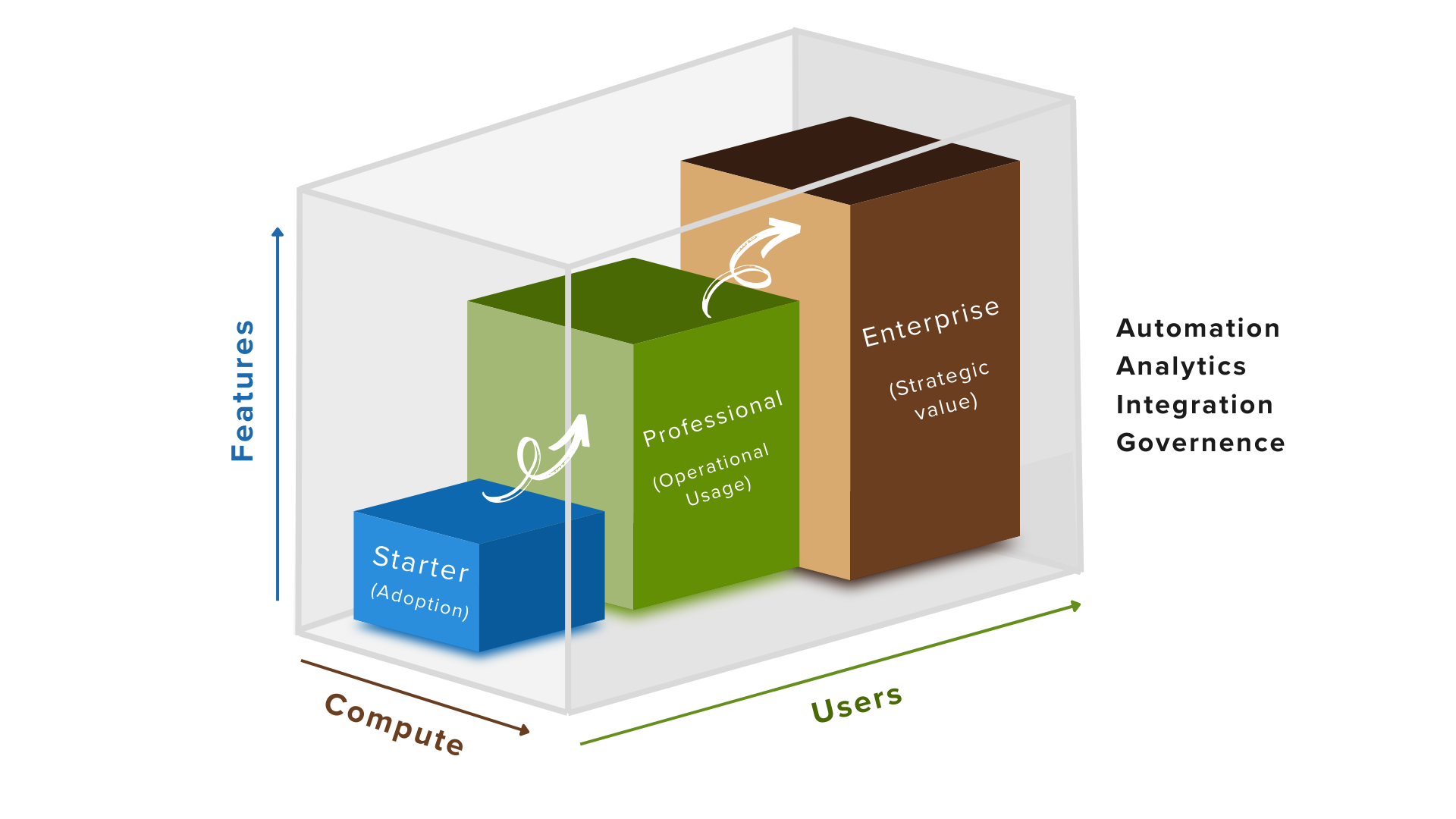
Computing Framework

3x3 SaaS Pricing Framework

A practical framework for designing SaaS pricing around buyer maturity, value depth, and operating constraints.

Pricing Framework SaaS Pricing Design 3 x 3 Value Matrix
3-3 Framework for SaaS Pricing Banner
Framework Overview

The 3x3 SaaS Pricing Framework is a practical way to design and communicate pricing by aligning three customer maturity bands with three value-depth bands. It is useful when a product has to balance adoption, monetization, and operational discipline without collapsing into arbitrary package design.

Framework Intent

Use pricing as a product architecture decision. Each pricing tier should reflect a different level of business commitment, product depth, and commercial readiness.

The Three Customer Bands

1. Emerging

Smaller buyers validating the problem, early teams, or low-complexity workflows.

2. Scaling

Organizations standardizing workflows, adding governance, and expanding usage across teams.

3. Strategic

Buyers treating the product as a platform capability with integration, compliance, and executive-level accountability.

The Three Value-Depth Bands

A. Core Utility

Essential workflows, controlled usage, and clear time-to-value.

B. Operational Leverage

Automation, collaboration, reporting, and policy-aware operations.

C. Strategic Control

Advanced governance, extensibility, deeper analytics, and enterprise operating alignment.

The 3x3 Matrix

When the two dimensions are combined, the matrix helps determine what should be packaged, gated, bundled, or reserved for premium commercial motion. This avoids underpricing advanced value while keeping entry-level adoption clear and credible.

Customer \ Value
Core Utility
Operational Leverage
Strategic Control
Emerging
Low-friction starter package
Growth-focused team package
Selective upsell or advisory-led motion
Scaling
Broad rollout baseline
Most commercially balanced package
Premium operational package
Strategic
Floor offering, rarely the destination
Governed deployment package
Enterprise or negotiated offer

Design Principles

  • Do not use feature count alone as a proxy for value.
  • Make the upgrade path legible to a buyer in under a minute.
  • Reserve governance, risk reduction, and integration depth for higher-value tiers.
  • Keep packaging tied to operating reality, not only to marketing segmentation.
Interactive Tool

SaaS Pricing Designer

Use the interactive Batoi tool to sketch, test, and refine pricing structure ideas against the framework.

Open Tool Open Tool
Authenticated page on batoi.com
Mathematical Representation

The framework can be expressed as a compact scoring model.

\[ V = w_uU + w_cC + w_fF \]
Terms
  • \(U\): users or seats
  • \(C\): compute or usage intensity
  • \(F\): feature capability depth
  • \(w_u,w_c,w_f\): business weights
Tier Thresholds
\(V < T_1\): Starter
\(T_1 \leq V < T_2\): Professional
\(V \geq T_2\): Enterprise

Once the tier is identified, indicative pricing inside a tier may be expressed as:

\[ P_t = a_t + \alpha_tU + \beta_tC + \gamma_tF \]

\(P_t\) is the price for tier \(t\); \(a_t\) is the base price for that tier; and \(\alpha_t,\beta_t,\gamma_t\) are tier-specific coefficients for seats, usage, and feature depth.

Use This Framework When
  • You need a pricing structure that reflects buyer maturity.
  • You want to separate baseline utility from strategic control.
  • You are aligning product packaging with commercial motion.
  • You need a common vocabulary across product, finance, and GTM.