
 Blogs
Blogs
Why Computing Maturity Matters for Modern Organizations
Computing maturity helps organizations understand whether their digital systems, delivery practices, security posture, data readiness, cost discipline, and governance are improving together.

Modern organizations are adding technology at a pace that often exceeds their ability to govern it. A company may add new software applications, cloud services, AI tools, automation workflows, analytics dashboards, integration layers, cybersecurity products, and external vendors within a short period. Each addition may solve an immediate problem. Yet, after some time, leaders begin to see a familiar pattern: more systems, but weaker ownership; more tools, but unclear governance; faster delivery, but uneven quality controls; AI experimentation, but poor data readiness; cloud adoption, but limited cost accountability.
Here, the idea of computing maturity becomes important. Computing maturity is not the same as IT maturity. It is also not the same as cloud maturity, software quality, cybersecurity maturity, or AI readiness alone. It is the combined organizational capability to design systems, deliver change, protect trust, use data and AI responsibly, manage cost and sustainability, and govern technology decisions through a clear operating model.
For leaders, this matters because technology failures rarely stem from a single isolated weakness. It usually comes from weak connections between architecture, delivery, security, data, cost, and governance.
A system may be well coded but poorly governed. A cloud environment may be scalable but wasteful. A team may release features quickly but lack security checks. A business may want to use AI but may not have reliable data definitions, ownership, or workflow controls. In each case, the issue is not the absence of technology. The issue is the absence of mature computing capability.
What Computing Maturity Means
Computing maturity should be seen as an operating capability, not as a technology checklist. We ask a simple yet demanding question: Can the organization deliberately, safely, and repeatedly improve its digital systems? This question is different from asking whether the organization has software, cloud infrastructure, APIs, dashboards, or AI tools. Those are assets. Maturity is about how those assets are designed, maintained, secured, improved, paid for, and governed.
A mature organization connects technical choices with business, institutional, or mission outcomes. It knows why a system exists, who owns it, how it changes, what risks it carries, what data it depends on, and how its cost and value are reviewed.
An immature organization may still have talented developers, modern tools, and high ambitions. But its improvement cycle remains reactive. Problems are fixed after escalation. Releases depend on individual effort. Security is added late. Data issues are discovered when reports conflict. Cloud bills are reviewed only after they become uncomfortable. Governance happens through meetings rather than through a working operating model.
Computing maturity helps leaders see these patterns before they become expensive.
The Six Dimensions of Computing Maturity
The Computing Maturity Diagnostic examines six connected dimensions. These dimensions are not isolated departments. They are parts of one capability system as illustrated in Figure 1 below.
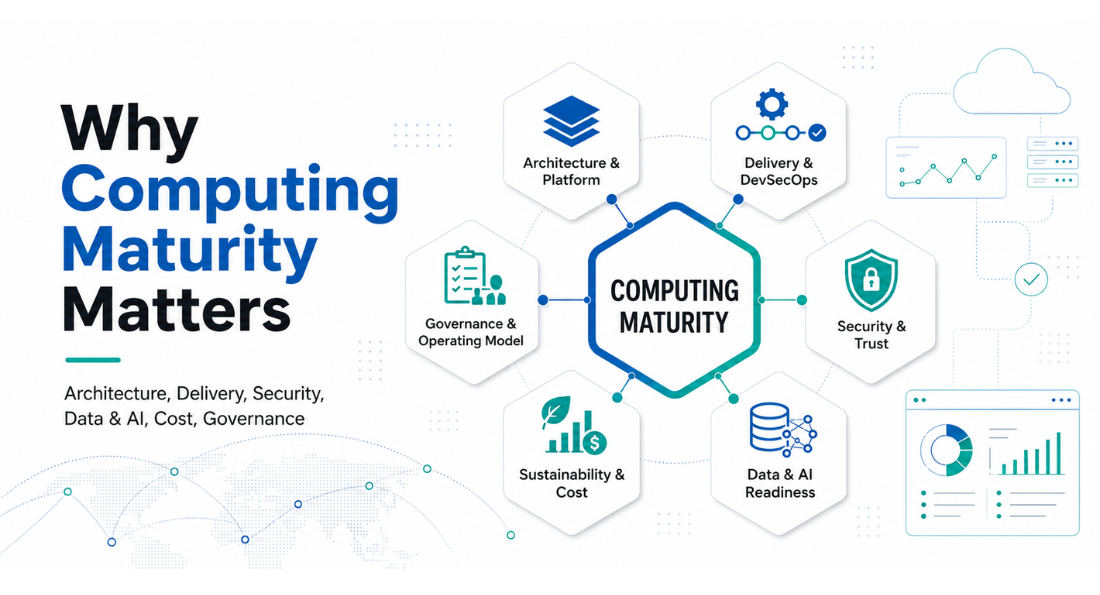
1. Architecture and Platform Maturity
Architecture maturity is about whether systems have clear boundaries, ownership, interfaces, and lifecycle decisions.
Many organizations grow through a chain of urgent technology decisions. A new application is added here, a database is created there, an integration is built quickly, a vendor tool is purchased, and a manual workaround becomes permanent. Over time, no one has a complete view of the system's structure.
Architecture maturity asks whether the organization understands its platforms, applications, APIs, data flows, dependencies, and technical debt. It also asks whether systems are designed for change, not merely for initial deployment.
A mature architecture does not require unnecessary complexity. It requires clarity: what each system does, where responsibilities lie, how systems interact, and how they will be retired, replaced, extended, or governed.
2. Delivery and DevSecOps Maturity
Delivery maturity is about whether change can be released safely and repeatedly.
An organization may have strong developers and still suffer from weak delivery discipline. Releases may depend on manual steps. Testing may be inconsistent. Security checks may happen late. A few individuals may hold deployment knowledge. Production feedback may not be returned to the engineering team quickly.
DevSecOps maturity brings development, security, and operations into a repeatable delivery process. It does not mean buying a set of tools and calling the process modern. It means quality checks, security checks, release controls, monitoring, rollback procedures, and feedback loops become part of normal work.
For leadership, this dimension matters because fast delivery without control creates hidden risks. On the other side, excessive control without automation slows down innovation. A mature delivery model balances speed, safety, and learning.
3. Security and Operational Trust
Security maturity is about whether trust is managed deliberately.
Modern systems carry sensitive data, business workflows, customer identities, payment flows, intellectual property, operational records, and sometimes regulated information. Security cannot remain a final review activity or a collection of policies nobody uses.
This dimension examines whether roles, permissions, trust boundaries, monitoring, incident handling, and operational controls are understood and maintained. It asks whether the organization knows who can access what, how access is reviewed, how events are monitored, how incidents are handled, and how lessons are fed back into the system.
Operational trust also includes reliability. A system that is insecure, unstable, undocumented, or poorly monitored cannot be trusted for serious organizational work.
Claims do not create trust. It is created by visible control, repeatable practice, and accountable ownership.
4. Data and AI Readiness
AI has made data readiness a board-level concern. Many organizations are experimenting with AI tools, copilots, chatbots, document assistants, analytics agents, and automation workflows. Yet AI readiness cannot be separated from data quality, data ownership, data definitions, access control, workflow design, and review criteria.
This dimension asks whether the data is reliable enough to support decisions and whether AI workflows are governed responsibly.
An organization may have databases and dashboards, but still lack shared definitions. Different teams may use different meanings for the same metric. Data may be duplicated across systems. Lineage may be unclear. Access may be too broad. AI experiments may begin before leaders know which workflows need human review, which outputs require validation, and which risks must be controlled.
AI readiness is not simply about subscribing to an AI tool. It is the ability to apply AI to useful work with adequate data, accountability, review, and safeguards.
5. Sustainability and Cost Discipline
Technology costs are often treated as a financial issue, but they are also engineering and governance issues.
Cloud platforms make it easy to provision resources. Software subscriptions are easy to add. Storage grows quietly. Logs accumulate. Environments remain active after projects end. Integrations continue running after their business purpose changes. Over time, waste becomes normal.
Sustainability and cost discipline examine whether infrastructure, software, cloud usage, and operational waste are visible and managed.
This dimension is not only about reducing bills. It is about making better technology decisions. Cost visibility helps leaders understand which systems create value, which resources are underused, which workloads need optimization, and which architectural choices create recurring waste.
Sustainability also includes the responsible use of computing resources. As digital systems expand, organizations should examine whether their technology growth is efficient, measurable, and aligned with long-term operational responsibility.
6. Governance and Operating Model
Governance maturity is about how technology decisions are reviewed, prioritized, funded, and improved.
Many organizations discuss governance only after something goes wrong: a failed project, a security incident, a cost spike, a vendor lock-in problem, or a compliance gap. Mature governance is different. It creates a regular decision model that considers value, risk, cost, capability, security, data, sustainability, and ownership before and after major technology decisions.
This dimension asks whether the organization has a clear operating model for computing decisions.
Who approves new systems? Who owns platforms? Who reviews architecture? Who manages risk? Who decides when to build, buy, integrate, retire, or automate? Who checks whether technology investments are producing the intended outcome?
Without an operating model, technology decisions become fragmented. Teams may work hard, but the organization does not learn systematically.
Why Maturity Is Usually Uneven
Most organizations do not mature evenly. It’s normal. A company may have strong developers but weak release discipline. A team may use cloud infrastructure well but lack cost ownership. An institution may have data systems but weak definitions and lineage. Leaders may approve AI pilots without workflow controls or review criteria. A business may invest heavily in cybersecurity tools but fail to maintain role reviews, incident drills, or vendor risk checks.
Uneven maturity becomes dangerous when it remains invisible. If leaders see only project completion, they may miss architectural fragility. If they see only cloud adoption, they may miss cost leakage. If they see only AI demos, they may miss the data's weaknesses. If they see only delivery speed, they may miss security gaps. If they see only compliance documents, they may miss whether controls work in daily operations.
The purpose of a maturity view is not to criticize teams. It is to make improvement visible. Once leaders can see unevenness, they can plan better. They can decide whether the next improvement cycle should focus on architecture, release discipline, access control, data governance, cloud cost visibility, or decision rights. Without that view, every problem feels urgent, and every investment competes without a common frame.
How Leaders Can Use a Diagnostic Result
The Computing Maturity Diagnostic is designed as a directional planning aid. It helps leaders assess their organization across architecture, delivery, security, data and AI, sustainability, and governance. The purpose is not to reproduce a full audit. It is to help leadership teams begin a structured conversation.
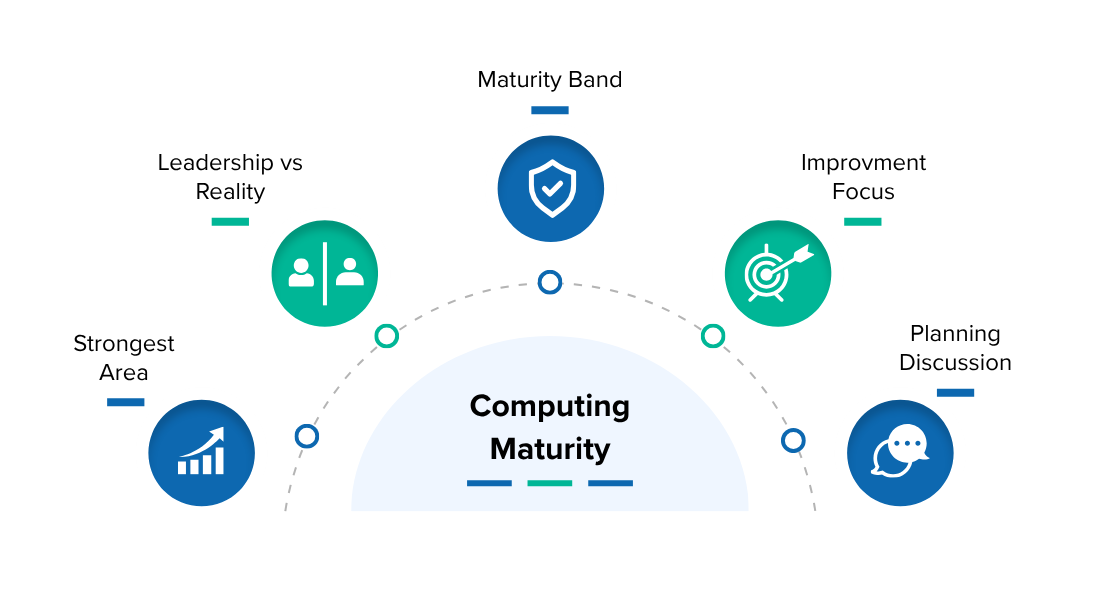
A useful diagnostic result should help an organization (as illustrated in Figure 2):
- Name its current maturity band;
- Identify its strongest and weakest dimensions;
- Decide where to focus the next improvement cycle;
- Compare leadership perception with operational reality;
- Begin a planning discussion without waiting for a large consulting exercise.
The result should be treated as a starting point. It can support leadership workshops, internal planning, technology roadmap discussions, vendor conversations, DevSecOps improvement plans, AI readiness reviews, or cloud cost reviews.
It is also important to say what the ‘diagnostic’ is not.
It is not a certification. It is not a security audit. It is not a compliance assessment. It is not a vendor evaluation. It does not replace technical due diligence, penetration testing, architecture review, privacy assessment, or formal governance work. Its value lies in helping leaders see whether their computing capability is improving as a connected system.
A Practical Way Forward
Organizations do not need to solve every technology weakness at once. They need to know where to start.
A computing maturity view gives leaders a practical way to move from scattered technology discussions to structured improvement. It connects architecture with delivery, delivery with security, security with data, data with AI, AI with governance, and governance with cost and sustainability.
It’s especially important now, when AI adoption, automation, cloud platforms, and digital services are entering every part of organizational life. Leaders need more than enthusiasm for new tools. They need a disciplined way to judge whether their organization is becoming more capable, more secure, more cost-aware, more data-ready, and more accountable.
Take the 5-minute Computing Maturity Diagnostic to assess your organization across architecture, delivery, security, data and AI, sustainability, and governance:
Start here: ashwinirath.com/computing/computing-maturity-diagnostic
Add your comments and queries
Share feedback, questions, or corrections. We read every message.