
 Blogs
Blogs
The 3×3 Framework for SaaS Pricing
Pricing a SaaS product is one of the most difficult decisions founders face. Engineering teams focus on building features. Sales teams focus on closing deals. Pricing often falls somewhere in between, shaped by competitor benchmarks or ad hoc experiments.

The 3×3 Framework for SaaS Pricing
Pricing a SaaS product is one of the most difficult decisions founders face. Engineering teams focus on building features. Sales teams focus on closing deals. Pricing often falls somewhere in between, shaped by competitor benchmarks or ad hoc experiments.
Yet most successful SaaS companies eventually converge toward a similar structure. Products scale across a small number of tiers, and those tiers differ along a few predictable dimensions.
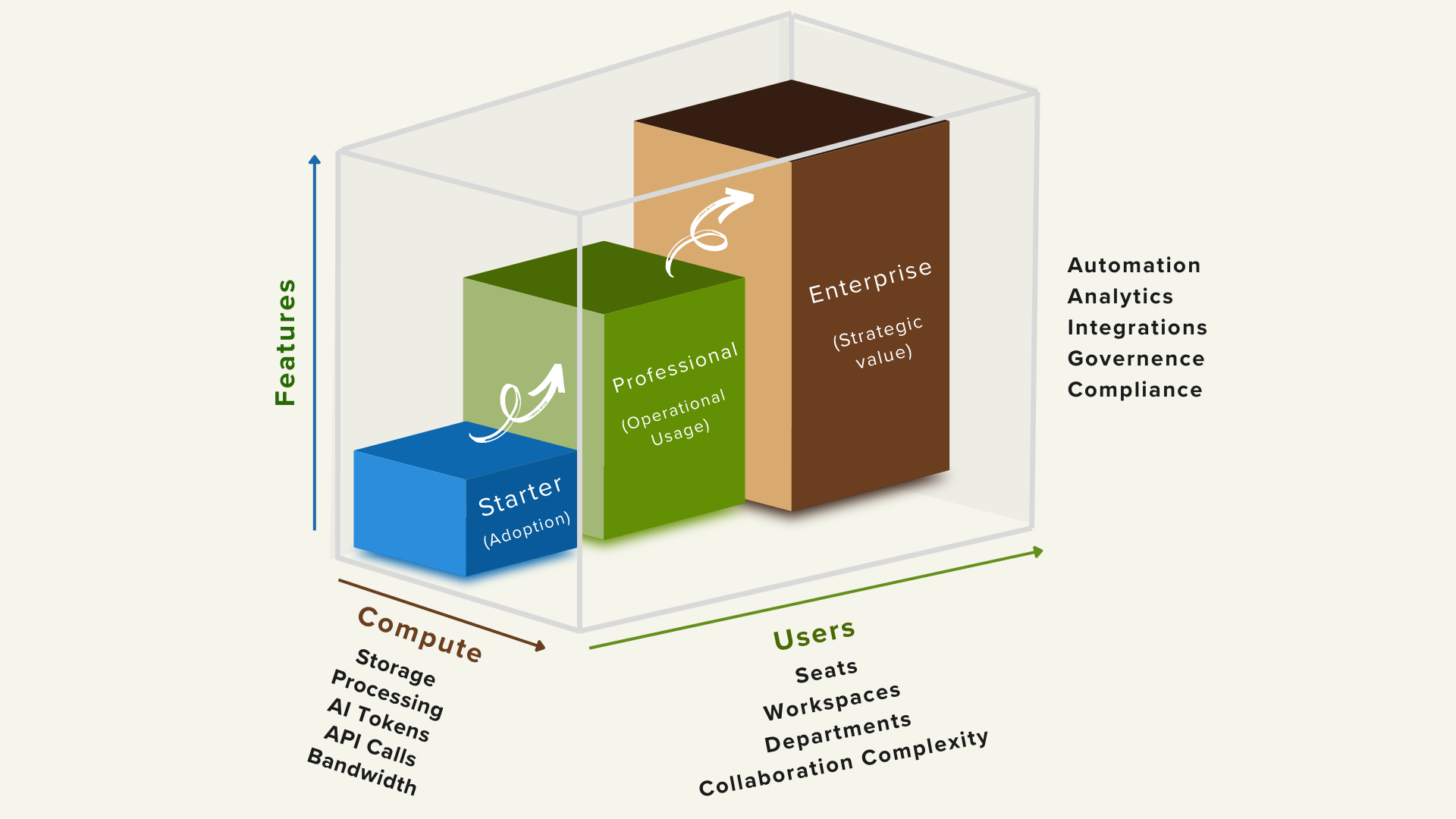
A useful way to think about this structure is the 3×3 SaaS Pricing Framework. The idea is simple: three tiers of customers and three drivers of value. When these dimensions are aligned, pricing becomes easier to design and easier for customers to understand.
The first dimension: three tiers
Most SaaS products organize their offerings into three core tiers: Starter, Professional, and Enterprise.
The Starter tier enables adoption. Its role is to allow individuals, freelancers, and small teams to begin using the platform with minimal friction. The focus here is accessibility rather than revenue. Some typical characteristics of this tier are an affordable entry price, a limited user count, essential functionality, and moderate resource limits. The Starter tier creates reach and product familiarity.
The Professional tier usually becomes the product's primary revenue engine. Organizations that depend on the platform for daily work typically move into this tier. Its typical characteristics are larger team collaboration, workflow automation, integrations with other tools, and analytics and reporting capabilities. In many SaaS businesses, the Professional tier ends up priced around four to five times the Starter tier. The increase reflects the value delivered when a product becomes part of operational workflows.
Enterprise customers operate at a different scale and require additional controls. Their needs typically include governance capabilities, compliance and audit features, advanced security, large-scale usage, and integration with enterprise systems. These requirements introduce additional complexity for the vendor as well. Enterprise pricing often sits twice the Professional tier, depending on deployment scale and service commitments. This tier captures strategic value rather than simple usage.
The second dimension: three pricing drivers
Across these tiers, pricing differences are usually driven by three underlying factors: Compute resources, Users, and Features.
Infrastructure or compute resources consumption represents a direct cost. Examples include storage, processing capacity, API usage, bandwidth, and AI tokens. As customer activity grows, infrastructure demand increases accordingly.
User count reflects operational scale. More users require identity and access management, onboarding support, collaboration infrastructure, and administrative oversight. For this reason, many SaaS platforms include per-seat pricing as part of their model.
Feature capability reflects the level of product sophistication. Examples include automation tools, analytics dashboards, integrations with external systems, governance controls, and compliance capabilities. As feature complexity grows, engineering effort, domain expertise, and support requirements increase as well.
The 3×3 structure
Combining these two dimensions produces a simple mental model - three tiers × three value drivers. Each tier increases at least one of the following:
- compute capacity
- number of users
- product capability
The result is a natural progression for customers. Individuals and small teams begin with Starter. Growing organizations move to Professional. Large companies adopt Enterprise capabilities. This structure keeps pricing predictable while allowing the product to scale with customer needs.
A practical rule for founders
When designing SaaS pricing, several practical guidelines help maintain balance.
- Keep the entry tier accessible to broaden adoption.
- Design the Professional tier carefully, since it typically generates most of the revenue.
- Reserve advanced governance and compliance capabilities for enterprise deployments.
- Differentiate tiers based on compute limits, user scale, and product capabilities.
These principles produce a pricing structure that customers can understand without complex negotiation.
Where this model works well
The 3×3 framework fits particularly well for products that combine infrastructure usage, collaboration, and feature capability. Examples include collaboration platforms, workflow and project systems, developer platforms, productivity tools, and cloud-based business software. In these products, compute resources, team size, and capability expansion all influence product value.
When other pricing approaches dominate
Some platforms rely heavily on usage-based pricing rather than tiered capability models. Examples include payment platforms, data warehouses, and AI inference services. In those systems, pricing is often tied to transaction volume or computational consumption. Even in those environments, however, capability tiers frequently appear as products mature.
A simple way to think about SaaS pricing
Many pricing strategies can become complex very quickly. The 3×3 framework provides a simple starting point.
- Three tiers of customers.
- Three drivers of value.
When pricing aligns with these dimensions, a SaaS product can scale naturally, from individual users to enterprise organizations, while maintaining clarity for both the vendor and the customer.
This article was originally published on LinkedIn.
Add your comments and queries
Share feedback, questions, or corrections. We read every message.